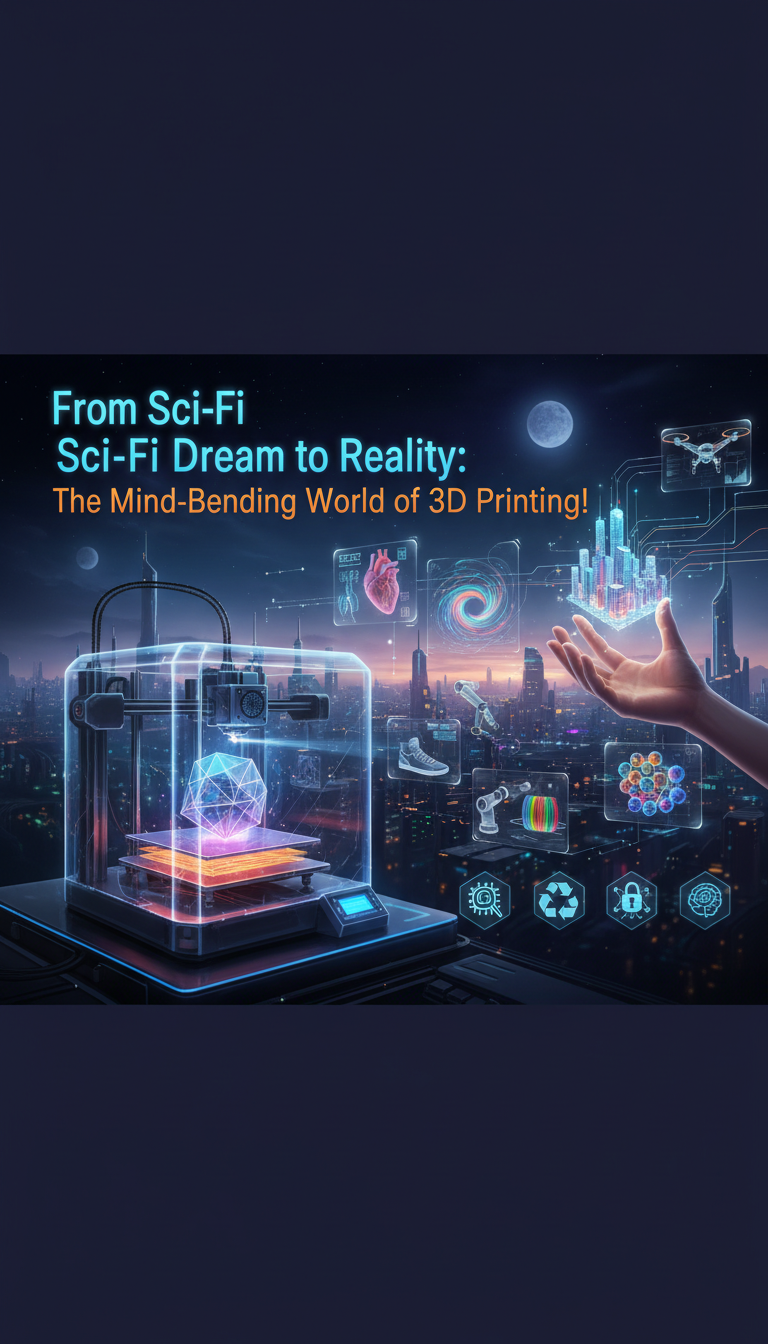
A transformative technology that builds objects layer by layer from digital blueprints, fundamentally altering traditional manufacturing.
Introduction
3D printing, also known as additive manufacturing, is a transformative technology that builds objects layer by layer from digital blueprints, fundamentally altering traditional manufacturing. It impacts various sectors, including bespoke medical implants and customized footwear.
The Basics of 3D Printing
The Core Process
- Design: Creating a digital model using Computer-Aided Design (CAD) software.
- Slicing: Dividing the digital design into numerous thin layers.
- Printing: The 3D printer deposits material layer by layer according to the sliced blueprint until the object is complete.
Types of 3D Printers
- FDM (Fused Deposition Modeling): Melts and extrudes plastic filament; common for prototypes, hobbyists, and practical objects.
- SLA/DLP (Stereolithography/Digital Light Processing): Uses light (laser or projector) to harden liquid resin; ideal for intricate details and high accuracy.
- Metal Printers: Fuse metal powders using lasers or electron beams; used for strong, durable parts in aerospace and heavy industry.
- Multi-material Jets: Capable of combining different substances in a single print.
Widespread Applications
- Manufacturing: Accelerating prototyping, enabling on-demand custom parts, and revolutionizing supply chains.
- Healthcare: Creating custom implants, prosthetics, and exploring bioprinting of functional organs.
- Aerospace & Auto: Producing lighter, stronger parts to improve fuel efficiency and performance.
- Consumer: Crafting custom gadgets, replacement parts, art, and even food.
History of 3D Printing
- Early Work: Dr. Hideo Kodama (Japan) conducted early experiments in photopolymerization in the ’80s.
- Pioneering Invention: Chuck Hull is credited as the “Father of 3D Printing” for inventing SLA (Stereolithography) in 1983.
- Commercialization: Hull’s company, 3D Systems, launched the first commercial 3D printer.
- Further Developments: SLS (Selective Laser Sintering) and FDM (Fused Deposition Modeling, developed by Stratasys) emerged, expanding material and application possibilities.
Initially, 3D printing was an expensive industrial tool. However, the open-source RepRap project and expiring patents in the 2000s democratized the technology, leading to the desktop printer revolution. Significant milestones include the printing of the first 3D organ (a bladder), detailed kidney models for surgical planning, and affordable prosthetic limbs.
Debates and Concerns Surrounding 3D Printing
Positive Aspects
- Creativity Unleashed: Empowers individuals to design and create personalized objects.
- Industry Revolution: Promises faster product development, reduced waste, and the creation of complex geometries.
- Environmental Potential: Offers the possibility of less material waste through on-demand printing.
Concerns
- Environmental Impact: Reliance on plastics, energy consumption, and e-waste are concerns.
- Accessibility: Still perceived as expensive and complicated for average consumers, with a steep learning curve and limited material options.
- Quality Control: Consistency and reliability of mechanical properties can vary.
- Job Displacement: Potential for automation to replace jobs in traditional manufacturing.
- Security Risks: Networked printers are vulnerable to cyber-attacks, impacting intellectual property and production.
Controversies and the Dark Side of Digital Fabrication
- Intellectual Property: The ease of downloading and printing designs poses challenges for patents, copyrights, and design rights, akin to digital piracy.
- Misuse: The ability to print untraceable firearms raises public safety and gun control issues. Potential for counterfeit goods and sabotage also exists.
- Bioprinting Ethics: Printing organs and tissues raises profound ethical questions regarding consent, organ trafficking, and the creation of artificial life.
- Health Risks: Desktop 3D printers can emit ultrafine particles and VOCs, potentially irritating lungs and causing health issues. Safety regulations are lagging.
- Energy Consumption: Some 3D printers can consume more energy than traditional manufacturing methods for equivalent output.
The Future of 3D Printing
Future Advancements
- Multi-Material Printing: Printers capable of combining multiple materials and colors in a single print.
- AI Integration: AI optimizing print settings, predicting failures, and enhancing automation.
- Advanced Scales: Nanoscale printing for electronics and advanced science, and 4D printing where objects change shape or properties post-printing.
- Increased Speed and Size: Innovations reducing print times and enabling larger-scale prints, including building walls.
- Hybrid Manufacturing: Combining 3D printing with traditional methods for enhanced precision and complexity.
- Cloud Connectivity: Enabling remote design, shared libraries, and global collaboration.
Future Vision
- Mainstream Manufacturing: Transitioning from prototyping to standard mass production.
- Mass Customization: On-demand production of personalized medical devices and consumer goods.
- Localized Production: Manufacturing parts at the point of need, reducing supply chain issues.
- Sustainability Focus: Development of recyclable, plant-based, and biodegradable materials.
- New Job Creation: Demand for designers, engineers, and technicians skilled in 3D printing.
Conclusion
3D printing has evolved from a concept to a reality, reshaping industries and offering vast possibilities. While its potential for innovation and customization is immense, it is crucial to address ethical dilemmas, environmental challenges, and safety concerns. The future promises a faster, multi-material, and more integrated 3D printing landscape, requiring thoughtful development, clear regulations, and responsible innovation.
